The tmux Book
Internals, Automation, Extension Engineering, and Production Operations.
Coming soon
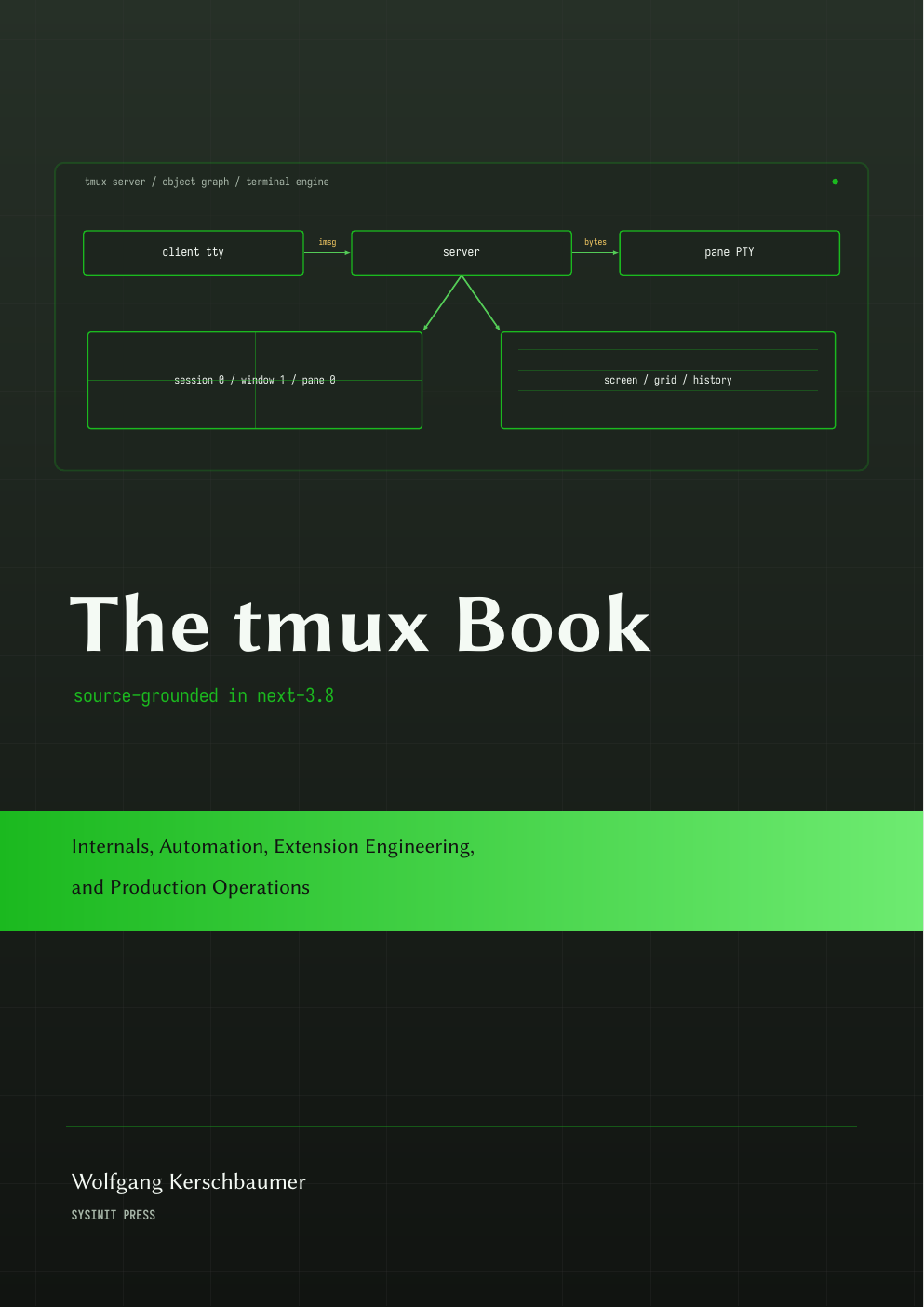
tmux is a persistent server with its own protocol, command language, and terminal engine. The book traces those pieces through a pinned C source tree and test suite while keeping documented behavior separate from implementation details. It shows how windows, winlinks, and panes relate in memory, how PTY output reaches a terminal, and why commands can finish out of order.
Status: all 48 chapters and 5 appendices are drafted and fact-checked (about 126,000 words). Runtime verification and external publication remain.
First edition ships DRM-free as PDF and EPUB, with free updates.
Reader poll Readers pick which Sysinit Press title we finish next. The tmux Book is on the ballot.
Vote for this bookHow tmux works behind the command line.
The first half explains tmux's object model, command parser, queues, and terminal engine. Later chapters cover automation, a complete configuration, plugin internals, and operational patterns. Open a part to see its chapters.
What this book assumes, and how to read it
Part 1 Foundations and Architecture 5 chapters
- 1 Why tmux
- 2 Building and Reading tmux
- 3 Clients, Servers, Sockets, and Protocol
- 4 The Object Graph
- 5 Events, Lifetimes, and Deferred Work
Part 2 Command, Configuration, and Policy Engines 7 chapters
- 6 The tmux Command Language
- 7 Arguments, Targets, and Context
- 8 The Command Queue
- 9 Configuration Loading and Reloading
- 10 Options, Scopes, Arrays, and Defaults
- 11 Formats, Styles, and Format Jobs
- 12 Keys, Tables, Hooks, and Mouse Events
Part 3 The Terminal Engine 10 chapters
- 13 The Terminal Engine
- 14 Spawning Panes and Owning PTYs
- 15 The Input State Machine
- 16 Characters, Cells, Colours, and Attributes
- 17 Screens, Grids, History, and Reflow
- 18 Layouts, Geometry, and Resize
- 19 Redraw, Damage, and TTY Output
- 20 Terminal Capabilities, Keys, and Colour Negotiation
- 21 Status Lines, Prompts, Menus, Popups, and Modes
- 22 Clipboard, Hyperlinks, and Images
Part 4 Expert Operation and Automation 5 chapters
- 23 Operating Sessions, Windows, and Panes
- 24 Copy Mode, Buffers, and Selection Semantics
- 25 Control Mode and Machine Interfaces
- 26 Named Servers, Multiuser Access, and Security
- 27 Performance, Diagnosis, Upgrade, and Recovery
Part 5 A Real Configuration Under the Microscope 4 chapters
- 28 Configuration Architecture and Load Order
- 29 The Local Key Model
- 30 Status, Formats, Hooks, and Naming
- 31 tmuxp, Shell, and Agent Integrations
Part 6 Extension Internals 13 chapters
- 32 The Plugin Surface and TPM
- 33 tmux-sensible
- 34 tmux-yank
- 35 tmux-logging
- 36 tmux-pain-control
- 37 tmux-jump
- 38 tmux-fingers
- 39 tmux-fzf-url
- 40 extrakto
- 41 tmux-pop
- 42 tmux-power-zoom
- 43 tmux-command-palette
- 44 tmux-window-name
Part 7 Production Patterns and Extension Engineering 4 chapters
- 45 The Incident-Response Workspace
- 46 Remote, Nested, SSH, and Mosh Workflows
- 47 Development, CI, and Declarative Sessions
- 48 Engineering and Auditing Extensions
Part 8 Appendices 5 appendices
- A Troubleshooting Field Guide
- B Commands, Options, Hooks, Formats, and Key Tables
- C Terminal Protocol and terminfo Field Guide
- D Sources, Reproducibility, Verification, and Version Migration
- E Glossary and Generated Subject Index
For engineers who already live in tmux.
This book is for developers, SREs, and platform engineers who use terminals professionally. It assumes basic tmux familiarity and comfort with processes, PTYs, and event loops. The book explains its source-reading workflow.
- Users who want to predict and automate tmux: control mode, named servers, formats, hooks, and declarative sessions.
- Operators who debug rendering, keys, colors, and capability problems with evidence rather than restarts.
- Plugin authors and auditors who want to read extensions as programs, with one source-level chapter per plugin.
Coming soon.
Join the shared Sysinit Press book list for release news, sample chapters, and updates to published editions. The first edition will include DRM-free PDF and EPUB files with free updates.
The signup uses double opt-in. Every message includes an unsubscribe link.